Free Communications Plan Template [Docs / DOCX]
When your client gets three conflicting answers about their campaign launch because team members weren't informed of deadline changes, you need a communications plan template to prevent this chaos.

This guide shows you exactly how to build a communications plan that keeps everyone on the same page, with a free template you can download and use today.
Why do agency communication fails
Most agencies repeat the same mistakes by assuming everyone's informed, failing to document anything, and letting critical updates disappear in email threads and Slack messages.
The biggest problem is assuming good communication just happens on its own.
Your account manager knows the deadline changed, but forgets to tell the designer. Your creative director approves an idea, but nobody tells the client. Someone goes on vacation with all the passwords, and everything comes to a halt.
A communications plan shows who tells what to whom and how for every project– from client onboarding to campaign launches. Without it, agencies face confusing messages, forgotten updates, unhappy clients, and missed opportunities.
What is a strategic communications plan?
It is your roadmap for who needs to know what, when, and how you'll tell them. It ensures clients stay informed about their projects through weekly updates via email or tools like ManyRequests (which has a built-in client feedback feature) that summarize progress, upcoming tasks, and challenges. At the same time, internal teams align without constant meetings.
Don't confuse this with a communication strategy framework. A strategy sets broad goals, such as "build stronger client relationships." A plan provides concrete steps, such as "hold monthly review calls on the first Tuesday and share campaign results within 48 hours of launch."
Communication plans deliver consistent client messaging, align teams across creative, account management, and production, prevent miscommunication, and create clear accountability. They save time through structured processes and boost client satisfaction by keeping everyone informed and aligned.
55 KNOTS, a creative design agency in Australia, faced the common challenge of juggling customer needs and team alignment. Without a clear system for who communicated what to whom, customer requests weren't reaching the right account managers, and team members weren't aligned on project status. This created confusion and slowed down their delivery process.
They solved this by implementing ManyRequests' client portal, which automatically assigns customer requests to specific account managers, ensuring everyone knew their responsibilities and clients always had a clear point of contact.
Understanding these common failures is the first step. Now, let's define exactly what a communications plan is and how it solves these problems.
Key elements of an effective communications plan
- Communication objectives and goals answer the "why." What do you need to accomplish? Make objectives specific, measurable, achievable, relevant, and time-bound.
Examples: "Increase client awareness of our new service by 30% within 60 days" or "Get client approval on creative concepts within five business days."
- The target audience and stakeholders identify who needs information. List clients wanting updates, internal teams coordinating projects, partners collaborating on campaigns, and media contacts. Map stakeholders by importance:
- Decision-makers who approve budgets
- Influencers who shape opinions
- End users who interact with your work.
A busy CEO wants brief, results-focused updates; a project manager needs detailed timelines. Creating a stakeholder communications plan ensures each group receives the right information at the right time.
- Key messages and a messaging framework define what you'll say. Use a simple hierarchy:
- Primary messages communicate your main idea
- Secondary messages support it
- Supporting points provide proof with examples or data.
- Communication channels and tactics determine how you'll deliver messages. Common channels include email for updates, project management tools for tracking, meetings for discussions, social media for external messaging, and reports for data, all matched to your audience based on urgency and complexity.
- Timeline and frequency create your schedule. Plan communication around project milestones with regular updates, like weekly emails; reserve major announcements for launches; and build in buffer time for approvals to avoid last-minute rushes.
- Roles and responsibilities should have clear ownership. Define who creates, approves, and distributes content, then establish escalation protocols that specify who to notify first and how to escalate urgent issues quickly.
- Success metrics and evaluation track what works. Monitor email open rates, response times, stakeholder satisfaction surveys, and on-time delivery rates to identify what's working and what needs adjustment.
Now that you understand the core elements of a communications plan, let's walk through exactly how to build one from scratch.
How to create a communications plan
Follow these steps to build a communications plan you can use right away without spending weeks on it.
Step 1: Define your communication objectives
Start with the "why." What do you need to achieve? Link objectives to your business or project outcomes using SMART criteria.
Example: "Ensure client approval of creative concepts within five business days."
Step 2: Identify your target audiences
List all stakeholders– internal teams, clients, executives, partners, and vendors– and prioritize them by influence. Then create audience profiles, noting their communication preferences: C-suite clients prefer concise email summaries, while marketing managers prefer detailed project updates.
Step 3: Develop your key messages
Create a message hierarchy with a primary core message, secondary supporting details, and specific proof points, then test drafts with team members for clarity and align messaging with the client's brand voice.
Step 4: Select your communication channels
Audit current methods to identify what works and existing gaps, then match channels to audience preferences, like email for executives and collaborative platforms for creative teams, while using centralized tools to reduce information silos.
Step 5: Create your communication schedule
Map timelines aligned with project milestones, including daily stand-ups, weekly status emails, and monthly reviews, and build buffer time for approval cycles to prevent delays.
Step 6: Assign roles and responsibilities
Designate communication owners for each channel and audience, and create approval workflows outlining who creates, reviews, approves, and distributes content. Account managers typically own client communication, and creative directors handle creative thinking.
Step 7: Set success metrics
Define measurable KPIs such as email open rates, response times, stakeholder satisfaction scores, and engagement rates; create feedback loops by regularly soliciting input from clients and teams; and review metrics monthly or quarterly to adjust strategies.
Step 8: Document everything
Compile objectives, audiences, messages, channels, schedules, roles, and metrics into one centralized, accessible document, schedule regular reviews, and treat the plan as a living document that evolves with your project needs.
Now, let's look at some practical communications plan examples for different agency scenarios.
Project communication plan for different situations
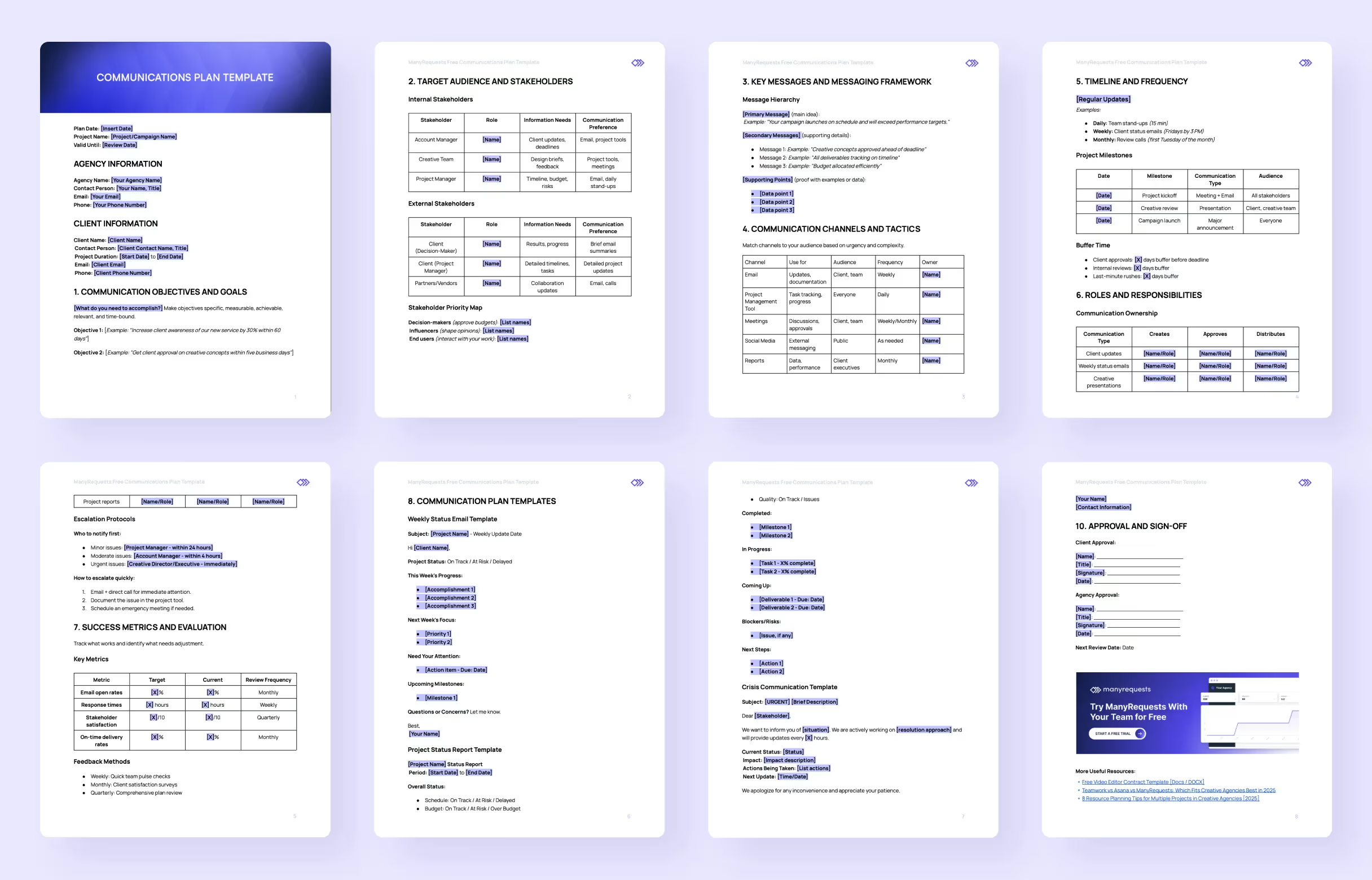
Different situations need different communication approaches. Here are examples of common agency scenarios.
- Project Launch Communication Plan. It covers pre-launch internal alignment and stakeholder notifications, launch execution with client approvals, and post-launch feedback monitoring with performance updates.
- Client Onboarding Communication Plan. It includes a welcome sequence introducing your agency and team, expectation-setting with project scope and timelines, process education explaining workflows and tools, feedback collection points, and regular check-ins to maintain transparency.
- Campaign Rollout Communication Plan. It coordinates multi-channel communication via email, social media, and project tools, schedules stakeholder updates at each phase, establishes crisis protocols to manage issues, and sets performance reporting schedules to share metrics.
- Crisis Communication Plan. It includes rapid-response protocols with immediate action steps, a stakeholder notification hierarchy prioritizing who gets informed when, message consistency frameworks with pre-approved messaging, and damage-control strategies to mitigate impact and rebuild reputation.
Having the correct framework is essential, but execution separates successful agencies from struggling ones. These best practices will help you implement your communications plan effectively and avoid the pitfalls that derail even well-designed plans.
Best practices for communication plans: What to do and what not to do
- Focus on what your audience cares about rather than team convenience, build flexibility to respond quickly to changes, over-communicate during critical phases, and use customized templates while tracking metrics to refine strategies.
- Keep your plan accessible in shared platforms and schedule regular reviews to incorporate lessons learned.
Just as important as what to do is knowing what to avoid.
- Don't overload communication channels, neglect your internal communications plan while focusing on external stakeholders, fail to coordinate your external communication plan with media contacts and partners, or let communication be one-way without confirming receipt and comprehension.
Beyond avoiding these mistakes, proactive habits are what transform a good communication plan into a competitive advantage.
- Be proactive by communicating updates before issues escalate, following up with stakeholders, embedding workflows into centralized tools, and establishing routines like daily stand-ups to build predictable flows.
- Encourage honest, clear communication, secure leadership support from the start, and regularly check what's working so you can adjust as the project evolves.
- Make communication automatic by building daily rituals: review your calendar each morning, confirm next steps after meetings, and block time for weekly updates so nothing falls through the cracks during busy periods.
- Get stakeholder buy-in by involving them in planning and showing how structured communication benefits everyone, then regularly audit what's working to make improvements.
Conclusion
You've just learned how to build a communications plan that stops the chaos at your agency.
Why do some agencies run smoothly while others are always confused and scrambling? It's not because one team is more thoughtful or more creative. It's because they have a clear system for who tells whom what, and everyone actually uses it.
Creating the plan is easy, but the real challenge is using it consistently and getting your entire team to follow it every day. That's where tools like ManyRequests help; it keeps all your client messages, project updates, and team tasks in one place so nothing gets forgotten.
Want to get everyone on the same page, finally? Grab our free template and test out ManyRequests for 14 days free to see how easy it is to keep your team coordinated and your clients informed.
FAQs
How do you write a communication plan?
Set SMART goals, identify your audiences, craft key messages, and choose communication channels. Build timelines, assign roles for creation and distribution, and track effectiveness with metrics. Document everything in a communication plan and review regularly. Templates make this faster and easier by giving you a proven structure to follow.
What is an example of a communication plan goal?
An example communication goal is "Ensure client approval of creative concepts within five business days" or "Increase client awareness of our new service by 30% within 60 days." These are specific, measurable, and time-bound.
How often should I update my communication plan?
Review and update your communication plan at least quarterly. Also, update it immediately when significant changes occur, like new team members, different client stakeholders, or when your current approach isn't working well.
.svg)